
In recent months – because innovation in this sector is measured almost on a daily basis – artificial intelligence has made further leaps forward in its evolution.
From the first chatbots that answered simple questions, we have now arrived at systems capable of planning, acting autonomously, adapting to the context and integrating into business workflows. It is no longer just a matter of answering a question, but of completely rethinking how companies work.
AI is not just assistance: it is strategy
Today, artificial intelligence can become a real driver of innovation. According to Microsoft, every euro invested in generative AI can bring a return of up to 3.7 times.
However, to achieve concrete results, a strategic vision is needed that involves the entire organisation: from corporate culture to data structure, technology and staff training.
Only with a strategic and informed approach will it be possible to unleash the full potential of artificial intelligence in the company. This means being able to:
– Improve the employee experience by making everyday work more fluid, intuitive and engaging.
– Evolve customer relationships through increasingly personalised, continuous and large-scale interactions.
– Automate repetitive and complex tasks, freeing up time and resources to focus on tasks with greater added value.
– Accelerate innovation, significantly reducing the time between an idea and its actual implementation.
The new face of AI: intelligent agents
Intelligent agents represent the new frontier of artificial intelligence. Unlike traditional chatbots, these systems do not just respond: they are designed to act, make decisions, handle exceptions and adapt dynamically to different contexts.
These intelligent agents enable a tangible leap forward in business processes:
They coordinate tools and workflows, connecting directly to internal systems to perform complex tasks in an automated and reliable manner.
– They continuously learn from data and improve over time, responding more and more accurately to operational needs and adapting to the dynamics of the company.
– They collaborate with human teams, assisting them in their daily activities and supporting them in making faster, more informed decisions that are consistent with business objectives.
– They integrate corporate knowledge sources and external data, offering more comprehensive, contextualised assistance that is relevant to real-life situations.
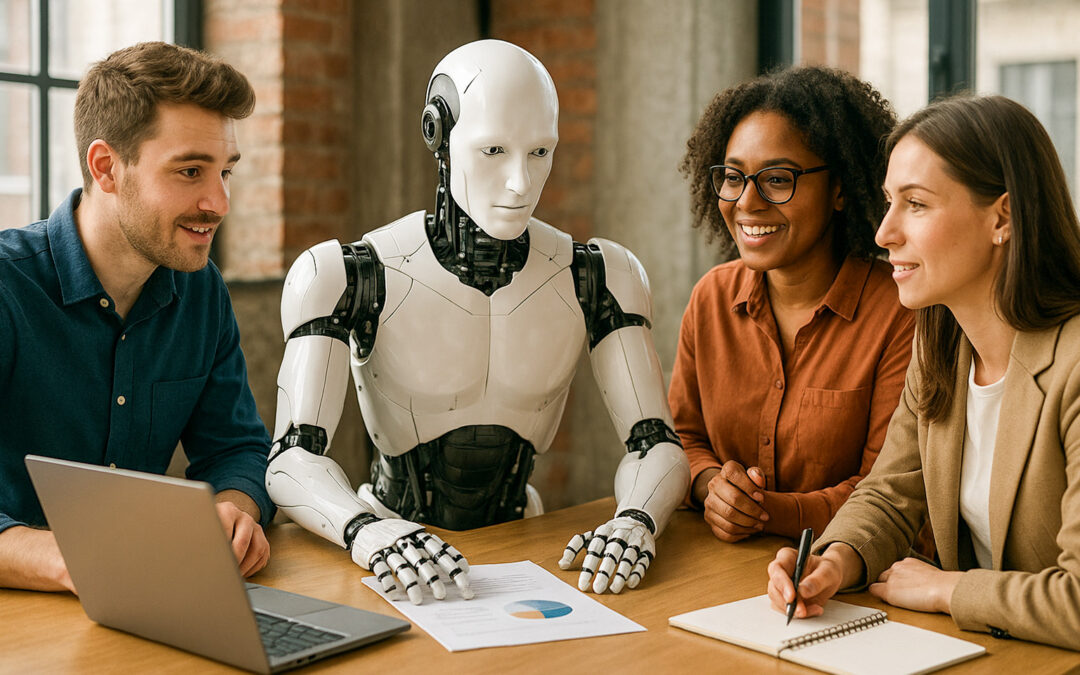
In practice, they behave like real digital collaborators: autonomous, proactive and adaptable. They are no longer simple conversational interfaces, but intelligent entities that combine natural language, business logic, software tools and operational memory.
Towards an agentic ecosystem
The future of AI in business is increasingly ecosystemic. This means creating environments where multiple intelligent agents work together, exchange information and orchestrate complex processes in a fluid and coordinated manner.
Thanks to technologies such as Microsoft Copilot Studio and modular, interoperable frameworks, it is now possible to design tailor-made agentic solutions that adapt to the context, learn from data and evolve over time.
In this scenario, the AI user interface is no longer an app as we know it: it is the agent itself. An entity capable of understanding, interacting, taking initiative and integrating seamlessly into the operational fabric of the company.
“Artificial intelligence is not just a technology to be adopted, but a new way of thinking about organisation,” says Andrea Nazari, Director of Moresi.com. ” Intelligent agents mark a paradigm shift: they are not tools that support people, but digital collaborators capable of acting independently, adapting to contexts and working side by side with human teams. At Moresi.com, as a Microsoft partner with Data & AI designation and specialisation in AI Platform on Microsoft Azure, we accompany companies in the transition from simple automation to advanced agent solutions. We design and integrate tailor-made agents, built around the processes, data and reality of each organisation. Our task is not only to introduce new technologies, but to help companies build an intelligent, concrete and sustainable future. ».